
When it comes to electric mobility, the focus is often on environmental or technological aspects. However, one of the most concrete factors that influence the daily choices of users concerns the real cost of using means of transport.
The case of the Ciao Piaggio, one of the most popular mopeds in the history of Italian mobility, offers an interesting opportunity for analysis. Today this vehicle can be used both in its original endothermic configuration and in the version transformed into an e-bike through an electric retrofit.
But how much does it really cost to use these two versions in the urban context?
To answer this question, we developed a comparative analysis based on verifiable technical data, considering an average urban cycle and a five-year period of use.
The reference mileage
According to official statistics published by ISTAT on the mileage of road vehicles in Italy, motorcycles and mopeds travel an average of about 2,300 kilometers per year.
Taking this value as a reference, the analysis considers a total distance of:
11,500 km over five years.
This is a realistic figure for the urban use of a light moped: short trips, home-work journeys and discontinuous use throughout the year.
The consumption of the endothermic Ciao
The Piaggio Ciao is historically known for its low fuel consumption. Technical sources indicate values between 32 and 45 km/l, depending on the conditions of use.
For this analysis, a prudential value of the following has been adopted:
40 km/l in real urban cycle
This means that to travel 100 km the engine requires approximately:
2.5 liters of gasoline
To this consumption must be added the oil necessary for the mixture at 2%, equal to approximately:
0.05 litres per 100 km
Considering an average petrol price of €1.85/litre and an average oil cost per mixture of €12/litre, the total energy cost of the endothermic version is approximately equal to:
€5.23 per 100 km.
The energy consumption of the Ciao transformed into an e-bike
In the case of the Ciao transformed into an e-bike, energy consumption depends directly on the range that can be obtained with a single charge.
Considering a battery capacity of about 720 Wh and a real urban range of about 30 km, the energy consumption is around:
2.4 kWh per 100 km
However, a conservative value has been adopted for the purposes of this analysis, assuming a range of 25 km per charging cycle.
In this scenario, energy consumption becomes:
2.88 kWh per 100 km
With an average cost of domestic electricity of €0.28/kWh, the cost of charging is approximately €0.28:
€0.81 per 100 km.
Battery life and autonomy
In real urban use, a battery can guarantee an average of about 30 km of travel per charging cycle, naturally varying according to the weight of the driver, the profile of the route and the driving style.
However, the conservative value of 25 km per cycle was used for this analysis to obtain a conservative estimate of energy consumption and overall battery life.
Considering an average life of between 800 and 1000 charging cycles, the theoretical battery mileage is between:
20,000 and 25,000 km
This value is significantly higher than the 11,500 km considered in the analysis period. For this reason, battery replacement was not included in the operating costs over the five years.
Management costs in the urban cycle
In addition to energy consumption, it is necessary to consider the main operating items that characterize the two versions of the vehicle.
In the case of the endothermic Ciao, in addition to fuel and mixed oil, some typical expenses of traditional mopeds come into play: insurance, property tax and ordinary mechanical maintenance.
The electric version, on the other hand, has a much simpler mechanical structure. The motor is integrated into the rear wheel hub and does not require external transmission systems, drastically reducing maintenance interventions.
The main cost items therefore become the consumption of electricity and the periodic replacement of the rear brake pads.
The economic comparison
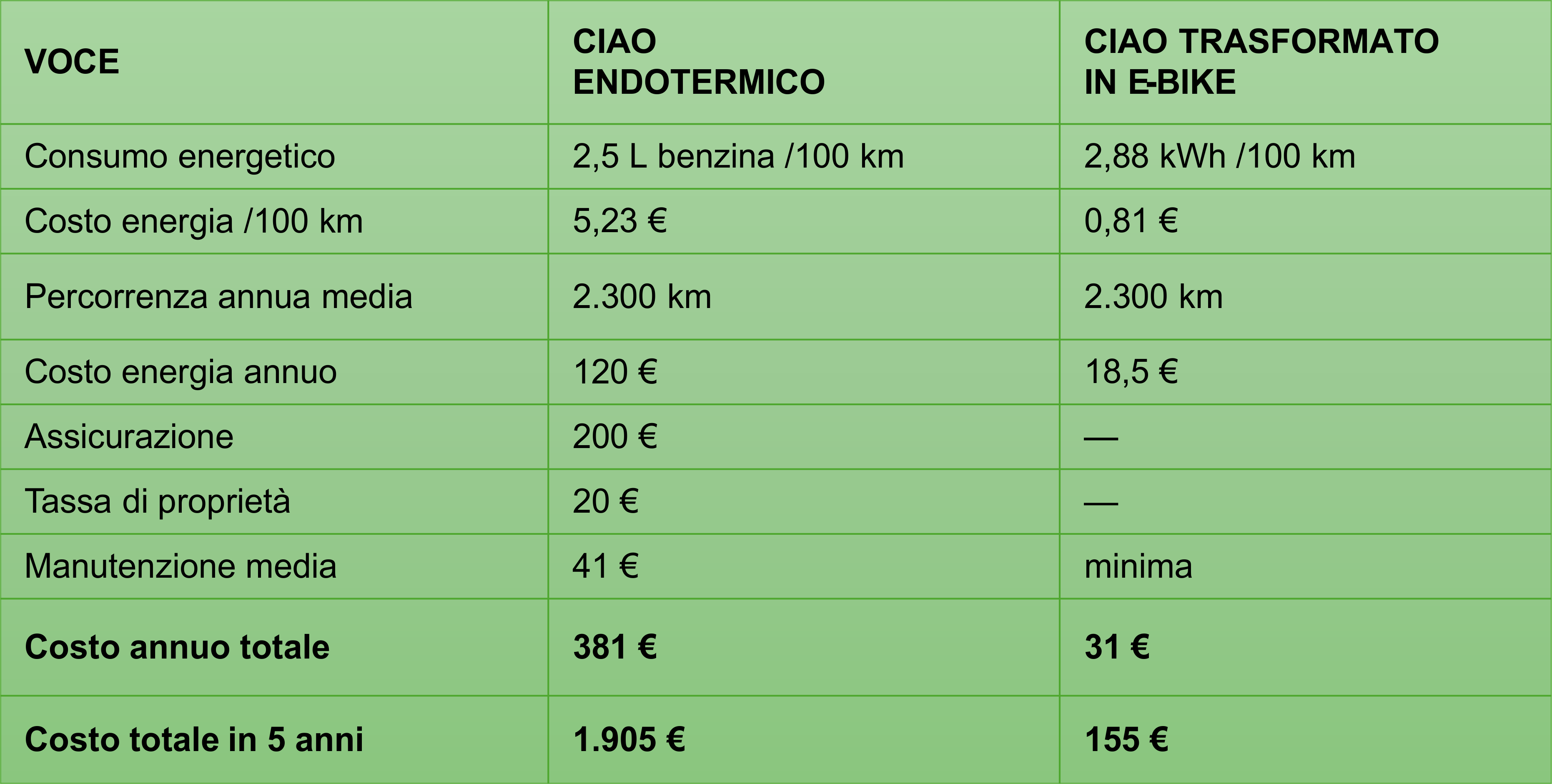
Considering all expense items and an average mileage of 2,300 km per year, the overall operating cost of the two versions over the five-year period is significantly different.
The endothermic Ciao has an average annual cost of about 381 euros, which brings the total expense in the analysis period to about 1,905 euros.
In the case of the Ciao transformed into an e-bike, the annual operating costs are extremely low, equal to about 31 euros per year for electricity and minimal maintenance.
Over five years, the total operating cost of the electric version is therefore around 155 euros.
A significant difference
The comparison highlights a very significant economic difference.
In the period considered, the operating cost of the Ciao transformed into an e-bike is more than twelve times lower than the endothermic version.
This result is not only due to the different cost of energy, but above all to the greater mechanical simplicity of the electrical system, which drastically reduces the necessary maintenance.
A perspective for urban mobility
The analysis of operating costs shows that the electric retrofit of a historic vehicle such as the Ciao Piaggio is not only a technological or environmental choice, but also an economically efficient solution in the long term.
The possibility of extending the life of an existing vehicle, while reducing energy consumption and operating costs, opens up an interesting prospect for the future of urban micromobility.
In this sense, electric retrofitting is not just a technical operation, but a concrete form of innovation applied to sustainable mobility.
You may also be interested in our blog article:
- E-BIKE TRANSFORMATION
- HISTORY OF CIAO PIAGGIO
- EVENTS
- ASSEMBLY OF KITS PURCHASED ONLINE
- OUR AUTHORIZED WORKSHOPS
- MAINTENANCE OF E-BIKES AMBRA ITALIA
- ELECTRIC MICRO-MOBILITY
- SCHOOL PROJECT: INNOVATING WITH AMBRA ITALIA
- ELEGANT AND SUSTAINABLE MOBILITY FOR RECEPTION STRUCTURES
- THE WORLD THROUGH CIAO: OUR CUSTOMERS' STORIES
- RESEARCH AND INNOVATION
- BEHIND THE SCENES OF AMBRA ITALIA
- Differences between Ciao SC and PX series frames and impact on transformation
- The people of Ciao
- Ciao endothermic vs Ciao transformed into an e-bike: analysis of operating costs
- How to read and correctly interpret the Operating Instructions
- Because Ciao is beautiful
- Ciao Piaggio and women: a bond to tell
- Interview with a technician: what is it like to work on an electric Ciao?
- The Silence of the Myth – Pedal-Powered Emotions with an Electric Ciao
- Comparative Analysis of Environmental Impact: Ciao Piaggio Endothermic vs Ciao transformed into an E-Bike
- Safety First: Checking the Safety Systems on Ciao Transformed into E-Bikes
- The Longevity of E-Bikes: How Ambra Italia Extends the Life Cycle of the Ciao Piaggio
- The role of Ciao Piaggio transformed into an e-bike in the challenges of contemporary mobility
- Urban Efficiency: How the Ciao Piaggio transformed into E-Bikes by Ambra Italia revolutionize city spaces with style
- Navigating the Regulations: Current and Future Legislation on Electric Micro Mobility
- Post-Transformation Personalization: Opportunities and Limitations
- Ciao Restoration: Options and Tips
- Comparison between the efficiency of an internal combustion engine and an electric engine in mobility
- Building Long-Lasting Customer Relationships: Strategies for Workshops
- Electric rebirth: the Ciao Piaggio in the era of micro mobility
- Ciao Piaggio in cinema and pop culture
- Electricity System Integration: Challenges and Solutions
- Document Writing Philosophy: Everything Under Control
- Micro-Electric Mobility vs. Long-Distance Electric Mobility: Analysis and Perspectives
- The technology behind the myth: mechanical innovations of the Ciao Piaggio
- Compliance with Regulations: Safety and Certifications
- Steps towards Authorization: How to Become an Authorized Ambra Italia Workshop
- Cleaning and Care of your Ciao transformed into an E-Bike: Tips for Aesthetic Maintenance
- The Operating Instructions and Other Documents for the Assembly and Control of the Processes
- Micro Mobility and Social Responsibility: How Companies Can Make a Difference
- From work to free time: the Ciao Piaggio as a symbol of freedom
- The Materials Used
- From Niche to Mainstream: The Evolution of the Electric Micro Mobility Market
- Joining the Ambra Italia Network: Advantages and Opportunities for New Workshops
- Tests on Critical Components: battery and motor system
- Competing icons
- The Ciao and the urban mobility revolution
- E-Bike or electric motorbike? The choice of the type of transformation determines the approval
- The Role of Electric Micro-Mobility in Reducing Urban Pollution
- Collaborating to Innovate: The Flow of Information between Headquarters and Workshops
- Optimize the battery life of your Ambra Italia e-bike
- Quality Controls on Materials
- Design evolution
- Structural Problems
- Security and Micro Mobility. Standards and Recommended Practices for Electric Driving
- The Emoving Days 2024
- The components of the kit: panoramic
- Excellence in the service: Ambra Italia quality standards
- Basic maintenance of the Ambra Italia-Bike: step by step Guide for Newfits
- Keep the original design
- The future is here
- Birth of an icon