
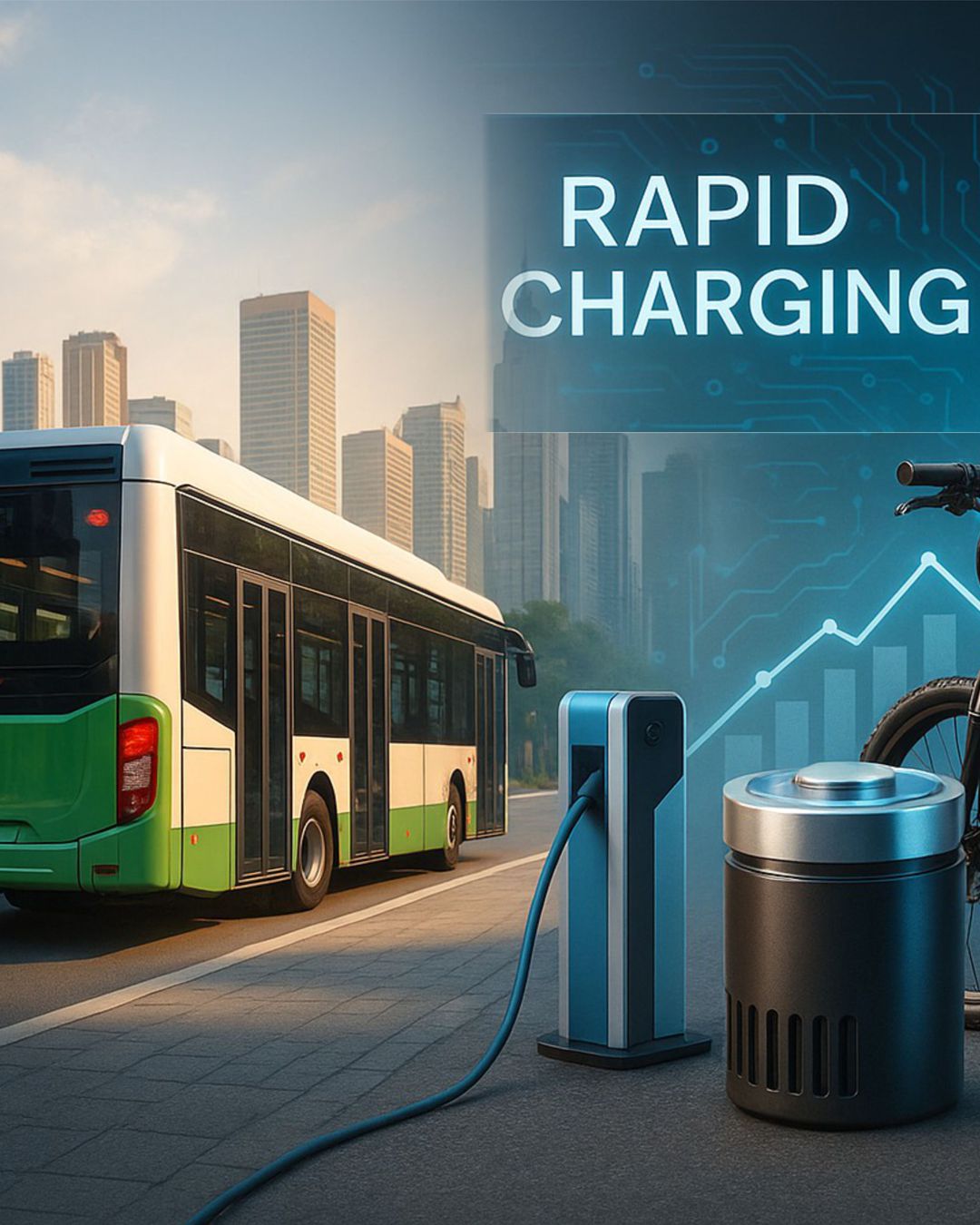
Recharge the battery of a smartphone in less time than it takes to pour a coffee. Or hop on an e-bike that charges during a short stop at traffic lights. Or again, an electric bus that recovers energy every time it opens the doors to pick up passengers. It's not science fiction: it's the promise of super capacitors, an energy storage technology that could revolutionize our relationship with energy, making everything faster, more efficient, and more sustainable.
As the world pushes towards widespread electric mobility and intelligent energy management, there is growing interest in solutions that overcome the limitations of traditional batteries. And super capacitors – also called ultracapacitors – are among the most promising candidates.
But what are they really? And why is it being talked about more and more often?
What are super capacitors and how do they work
Super capacitors are devices that can store and release energy extremely quickly, much faster than conventional batteries. Unlike the latter, which store energy through slow chemical reactions, super capacitors are based on a physical phenomenon: the separation of electric charge between two electrodes, immersed in an electrolyte.
It's a bit like having a water tank with a very large tap: the water (energy) comes in and out almost instantly. No chemical reactions, no waiting.
The most advanced models – called pseudo-capacitors – use innovative materials such as carbon nanotubes, graphene, metal oxides and three-dimensional structures, which expand the useful surface area and greatly improve their performance.
The advantages of the new generation
The new generation of super capacitors brings with it significant benefits, often out of scale compared to traditional batteries.
- Ultra-fast charging: we are talking about seconds or fractions of a second.
- Almost unlimited life cycles: withstand hundreds of thousands of refills without losing efficiency.
- Flexibility and safety: some graphene-based models are even foldable and free of liquid or flammable components.
- Compatibility with wearables and microelectronics, ideal for the Internet of Things (IoT) and proximity electronics.
Current limitations and technological challenges
Like any emerging technology, super capacitors also have weaknesses.
The main one is their low energy density: they can store much less energy than lithium-ion batteries. A super capacitor can discharge in seconds... but also to exhaust all his charge just as quickly.
Added to this is the problem of self-discharge: if not used, they tend to lose energy within a few days. And then there's the question of cost: advanced materials such as MXenes or high-entropy oxides (HEOs) offer enormous potential but are still difficult to produce at scale.
Real applications: small daily miracles
Despite the limitations, super capacitors are already finding concrete uses.
- In portable electronics, to charge devices in seconds.
- In public transport, such as on some city buses that recharge at stops and leave without heavy batteries.
- In foldable devices, thanks to flexible solutions based on graphene.
- In industrial systems, where they can provide immediate power in the event of a power outage (UPS) or act as an energy buffer in high-demand processes.
A replacement of the batteries? Not quite
Super capacitors are not intended to replace batteries, at least not in the short term. Rather, they work in synergy with them.
In the automotive industry, for example, they are used to:
- Recuperating energy during braking (KERS),
- Provide extra energy during acceleration,
- Extend the service life of the main batteries.
In urban areas, some electric buses work exclusively with super capacitors, covering short distances with fast and continuous recharging. In e-bikes and mobile devices, they do not offer enough range today, but they could soon be added to batteries to handle power peaks and reduce charging times.
Looking to the future
The future of super capacitors will depend on three key words: density, cost, and scalability.
If these barriers are overcome, we will be able to see:
- E-bikes that charge in less than a minute,
- Battery-capacitor hybrid systems in electric vehicles,
- Accumulators for smart grids and stabilization of energy grids,
- Wearable devices powered efficiently, flexibly, and securely.
We just have to wait for developments. But the direction is clear: time – literally – is becoming energy.
Sources and Insights
- Supercapacitors: what they are and their applications — Mecalux blog A clear and practical overview of efficiency, differences with batteries, and real-world applications such as industrial logistics. Link
- Supercapacitors and their relationship to batteries — DigiKey Italy Detailed analysis of the differences between supercapacitors and batteries, with examples of use in electronic systems and IoT. Link
- Supercapacitors, supercapacitors — Energoclub Technical insight into operation (EDLC), durability, power density, uses in transport and smart-city solutions. Link
- Supercapacitors — Wikipedia, the free encyclopedia (ITA)
Accessible theoretical introduction with definitions, structure, advantages, and limitations of the technology (updated edition). Link
- E-BIKE TRANSFORMATION
- HISTORY OF CIAO PIAGGIO
- EVENTS
- ASSEMBLY OF KITS PURCHASED ONLINE
- OUR AUTHORIZED WORKSHOPS
- MAINTENANCE OF E-BIKES AMBRA ITALIA
- ELECTRIC MICRO-MOBILITY
- SCHOOL PROJECT: INNOVATING WITH AMBRA ITALIA
- ELEGANT AND SUSTAINABLE MOBILITY FOR RECEPTION STRUCTURES
- THE WORLD THROUGH CIAO: OUR CUSTOMERS' STORIES
- RESEARCH AND INNOVATION
- BEHIND THE SCENES OF AMBRA ITALIA
- Differences between Ciao SC and PX series frames and impact on transformation
- The people of Ciao
- Ciao endothermic vs Ciao transformed into an e-bike: analysis of operating costs
- How to read and correctly interpret the Operating Instructions
- Because Ciao is beautiful
- Ciao Piaggio and women: a bond to tell
- Interview with a technician: what is it like to work on an electric Ciao?
- The Silence of the Myth – Pedal-Powered Emotions with an Electric Ciao
- Comparative Analysis of Environmental Impact: Ciao Piaggio Endothermic vs Ciao transformed into an E-Bike
- Safety First: Checking the Safety Systems on Ciao Transformed into E-Bikes
- The Longevity of E-Bikes: How Ambra Italia Extends the Life Cycle of the Ciao Piaggio
- The role of Ciao Piaggio transformed into an e-bike in the challenges of contemporary mobility
- Urban Efficiency: How the Ciao Piaggio transformed into E-Bikes by Ambra Italia revolutionize city spaces with style
- Navigating the Regulations: Current and Future Legislation on Electric Micro Mobility
- Post-Transformation Personalization: Opportunities and Limitations
- Ciao Restoration: Options and Tips
- Comparison between the efficiency of an internal combustion engine and an electric engine in mobility
- Building Long-Lasting Customer Relationships: Strategies for Workshops
- Electric rebirth: the Ciao Piaggio in the era of micro mobility
- Ciao Piaggio in cinema and pop culture
- Electricity System Integration: Challenges and Solutions
- Document Writing Philosophy: Everything Under Control
- Micro-Electric Mobility vs. Long-Distance Electric Mobility: Analysis and Perspectives
- The technology behind the myth: mechanical innovations of the Ciao Piaggio
- Compliance with Regulations: Safety and Certifications
- Steps towards Authorization: How to Become an Authorized Ambra Italia Workshop
- Cleaning and Care of your Ciao transformed into an E-Bike: Tips for Aesthetic Maintenance
- The Operating Instructions and Other Documents for the Assembly and Control of the Processes
- Micro Mobility and Social Responsibility: How Companies Can Make a Difference
- From work to free time: the Ciao Piaggio as a symbol of freedom
- The Materials Used
- From Niche to Mainstream: The Evolution of the Electric Micro Mobility Market
- Joining the Ambra Italia Network: Advantages and Opportunities for New Workshops
- Tests on Critical Components: battery and motor system
- Competing icons
- The Ciao and the urban mobility revolution
- E-Bike or electric motorbike? The choice of the type of transformation determines the approval
- The Role of Electric Micro-Mobility in Reducing Urban Pollution
- Collaborating to Innovate: The Flow of Information between Headquarters and Workshops
- Optimize the battery life of your Ambra Italia e-bike
- Quality Controls on Materials
- Design evolution
- Structural Problems
- Security and Micro Mobility. Standards and Recommended Practices for Electric Driving
- The Emoving Days 2024
- The components of the kit: panoramic
- Excellence in the service: Ambra Italia quality standards
- Basic maintenance of the Ambra Italia-Bike: step by step Guide for Newfits
- Keep the original design
- The future is here
- Birth of an icon