
A power plant so small that you can go around it, but so powerful that it provides energy for years on end, silently and without local emissions. Not a utopia, but a concrete concept: micro-reactors (micro-modular reactors) are opening a new frontier for the energy of the future.
What is a nuclear micro-reactor?
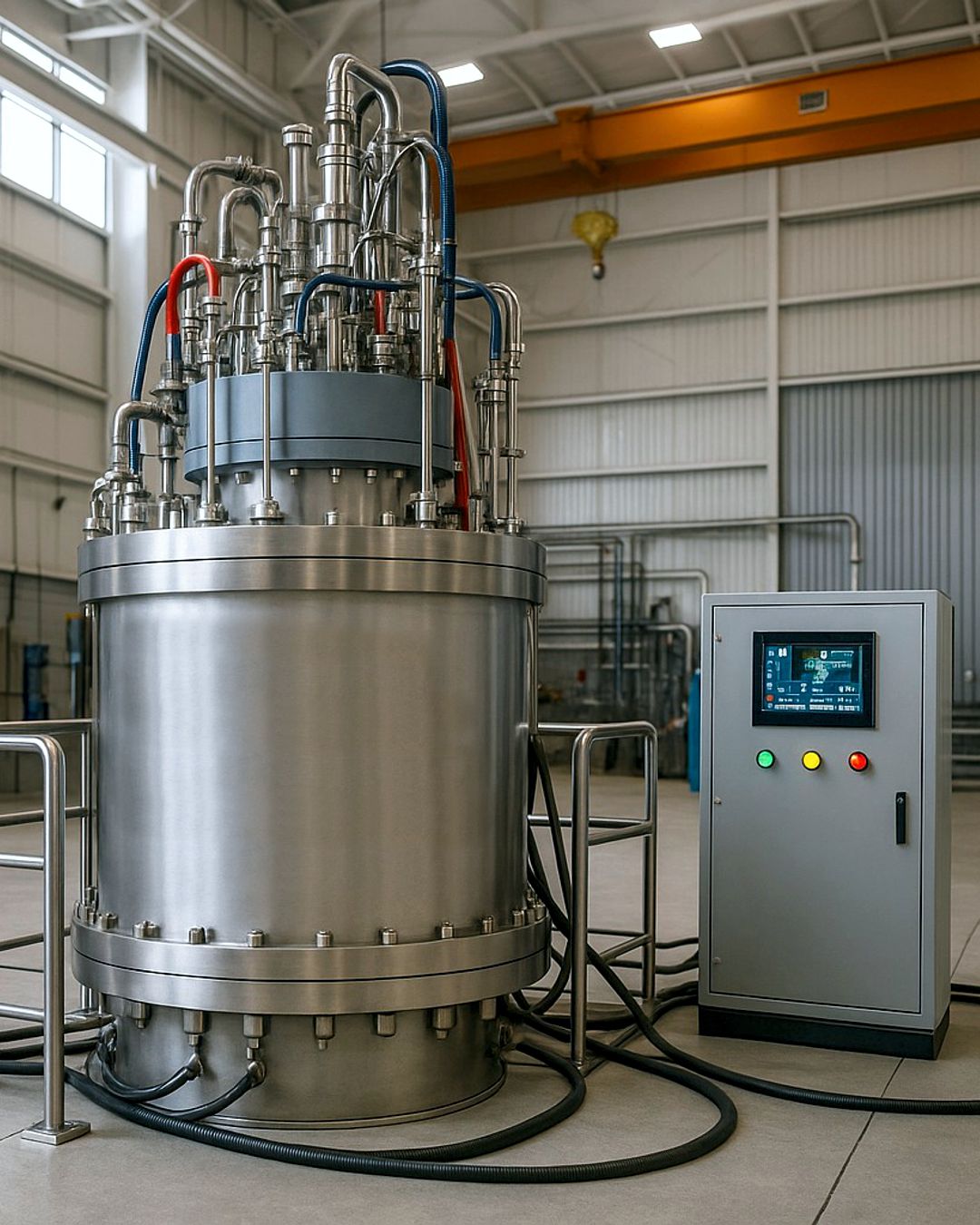
These devices employ state-of-the-art nuclear technologies in a small size. Typically, their power is around 1 megawatt electric (MWe), but they can be aggregated into scalable systems ranging from megawatts to gigawatts. Their modularity allows them to be mass-produced, installed where needed and operate autonomously, with minimal maintenance and advanced safety standards.
Some designs run on helium as a cooling fluid — safe, stable, and ideal for eliminating water dependency in traditional systems. Their robustness and reliability also make them suitable for remote or isolated environments: from military bases to islands, data centers or energy-vulnerable communities.
And the dross? A manageable problem, but not negligible
One of the main concerns related to nuclear energy concerns the management of radioactive waste. Even in the case of micro-reactors, although they produce much smaller quantities than traditional power plants, the problem does not disappear. The waste generated – in particular, spent fuel – requires safe storage for very long times, although some new generation technologies, such as breeder reactors or lead-cooled reactors, aim to recycle part of the fuel, significantly reducing the volume and hazardousness of waste. In Italy, the issue is even more delicate: the national repository for radioactive waste has not yet been built, and there remains a knot to be untied for any possible revival of the atom, whether micro or large. However, the small size of modular reactors also facilitates the logistics of waste, which could be transported and treated centrally in a more efficient and traceable way.
Italy and micro-reactors: new openings
After almost forty years of denuclearization, Italy is preparing to write a new chapter: a strategy is emerging to reintroduce nuclear production, not so much for large power plants, but for advanced modules such as SMRs and AMRs.
In addition, the establishment of Nuclitalia, an alliance between Enel, Leonardo, and Ansaldo Energia, with the aim of leading research on next-generation modular reactors, has recently been established.
Italy does not look only to the mainland. Thanks to an agreement between ENEA and the Italian Space Agency (ASI), a study is underway on micro-reactors designed to power lunar bases or stations in deep space, where solar energy is difficult to obtain and continuity is vital.
Perspectives and areas of use
Compact micro-nuclear reactors promise silent revolutions:
- Clean and on-demand energy, where renewables are not enough or do not arrive.
- Always-on urban data centers, without depending on congested networks.
- Energy autonomy in construction sites, mines, or isolated communities, reducing emissions and logistics costs.
Despite the advantages, there are still unresolved issues. SMRs, which are larger than micro-reactors, are expected to be available by 2030 in Europe — but only at pilot level. Some companies already active, such as Ultra Safe Nuclear Corporation, have encountered financial difficulties in transforming the experimentation into real plants on the Italian territory.
Sources and insights
- Terra Innovatum Introduces ONLY Micro-Reactor (1 MWe) — World Nuclear News. Link
- U.S. Partnership to Commercialize SOLO Micro-Reactor — World Nuclear News. Link
- Micro-reactors for data centers in smart cities — CERIDAP. Link
- Italy towards the reintroduction of nuclear power with micro-reactors — Reuters. Link
- Nuclitalia: advanced nuclear research in Italy — Reuters. Link
- Italy and the return to the atom as a complement to renewables — Le Monde. Link
- Micro-reactors for space energy: ENEA-ASI AGREEMENT — ENEA / Euronuclear. Link
- E-BIKE TRANSFORMATION
- HISTORY OF CIAO PIAGGIO
- EVENTS
- ASSEMBLY OF KITS PURCHASED ONLINE
- OUR AUTHORIZED WORKSHOPS
- MAINTENANCE OF E-BIKES AMBRA ITALIA
- ELECTRIC MICRO-MOBILITY
- SCHOOL PROJECT: INNOVATING WITH AMBRA ITALIA
- ELEGANT AND SUSTAINABLE MOBILITY FOR RECEPTION STRUCTURES
- THE WORLD THROUGH CIAO: OUR CUSTOMERS' STORIES
- RESEARCH AND INNOVATION
- BEHIND THE SCENES OF AMBRA ITALIA
- Differences between Ciao SC and PX series frames and impact on transformation
- The people of Ciao
- Ciao endothermic vs Ciao transformed into an e-bike: analysis of operating costs
- How to read and correctly interpret the Operating Instructions
- Because Ciao is beautiful
- Ciao Piaggio and women: a bond to tell
- Interview with a technician: what is it like to work on an electric Ciao?
- The Silence of the Myth – Pedal-Powered Emotions with an Electric Ciao
- Comparative Analysis of Environmental Impact: Ciao Piaggio Endothermic vs Ciao transformed into an E-Bike
- Safety First: Checking the Safety Systems on Ciao Transformed into E-Bikes
- The Longevity of E-Bikes: How Ambra Italia Extends the Life Cycle of the Ciao Piaggio
- The role of Ciao Piaggio transformed into an e-bike in the challenges of contemporary mobility
- Urban Efficiency: How the Ciao Piaggio transformed into E-Bikes by Ambra Italia revolutionize city spaces with style
- Navigating the Regulations: Current and Future Legislation on Electric Micro Mobility
- Post-Transformation Personalization: Opportunities and Limitations
- Ciao Restoration: Options and Tips
- Comparison between the efficiency of an internal combustion engine and an electric engine in mobility
- Building Long-Lasting Customer Relationships: Strategies for Workshops
- Electric rebirth: the Ciao Piaggio in the era of micro mobility
- Ciao Piaggio in cinema and pop culture
- Electricity System Integration: Challenges and Solutions
- Document Writing Philosophy: Everything Under Control
- Micro-Electric Mobility vs. Long-Distance Electric Mobility: Analysis and Perspectives
- The technology behind the myth: mechanical innovations of the Ciao Piaggio
- Compliance with Regulations: Safety and Certifications
- Steps towards Authorization: How to Become an Authorized Ambra Italia Workshop
- Cleaning and Care of your Ciao transformed into an E-Bike: Tips for Aesthetic Maintenance
- The Operating Instructions and Other Documents for the Assembly and Control of the Processes
- Micro Mobility and Social Responsibility: How Companies Can Make a Difference
- From work to free time: the Ciao Piaggio as a symbol of freedom
- The Materials Used
- From Niche to Mainstream: The Evolution of the Electric Micro Mobility Market
- Joining the Ambra Italia Network: Advantages and Opportunities for New Workshops
- Tests on Critical Components: battery and motor system
- Competing icons
- The Ciao and the urban mobility revolution
- E-Bike or electric motorbike? The choice of the type of transformation determines the approval
- The Role of Electric Micro-Mobility in Reducing Urban Pollution
- Collaborating to Innovate: The Flow of Information between Headquarters and Workshops
- Optimize the battery life of your Ambra Italia e-bike
- Quality Controls on Materials
- Design evolution
- Structural Problems
- Security and Micro Mobility. Standards and Recommended Practices for Electric Driving
- The Emoving Days 2024
- The components of the kit: panoramic
- Excellence in the service: Ambra Italia quality standards
- Basic maintenance of the Ambra Italia-Bike: step by step Guide for Newfits
- Keep the original design
- The future is here
- Birth of an icon