
In the landscape of energy storage technologies, lithium-sulfur (Li-S) batteries have captured the attention of researchers and industries because they promise a significant leap compared to current lithium-ion batteries. In the face of the growing demands for autonomy — from electric mobility to stationary storage — this energy chemistry is proposed as one of the most interesting for the future of advanced energy systems.
Superior theoretical capability
One of the main reasons for the interest in Li-S batteries is their high theoretical energy capacity. The presence of sulfur in the cathode makes it possible to achieve much higher specific capacity values than the materials used in traditional batteries.
In practical terms, this means being able to create lighter and more energetic storage systems, capable of significantly increasing the range of electric vehicles and reducing the overall weight of battery packs.
Advantages in terms of materials and sustainability
Another central element is the composition of the materials. Sulfur is abundant, cheap, and less environmentally problematic than critical metals such as cobalt, nickel, or manganese.
This aspect makes lithium-sulfur batteries particularly interesting in terms of:
- cost reduction,
- security of supply chains,
- environmental sustainability.
In the long run, this feature could help make energy storage more accessible and less dependent on strategic resources.
Technological Challenges and Critical Issues
Despite its great potential, Li-S technology still has major technical limitations.
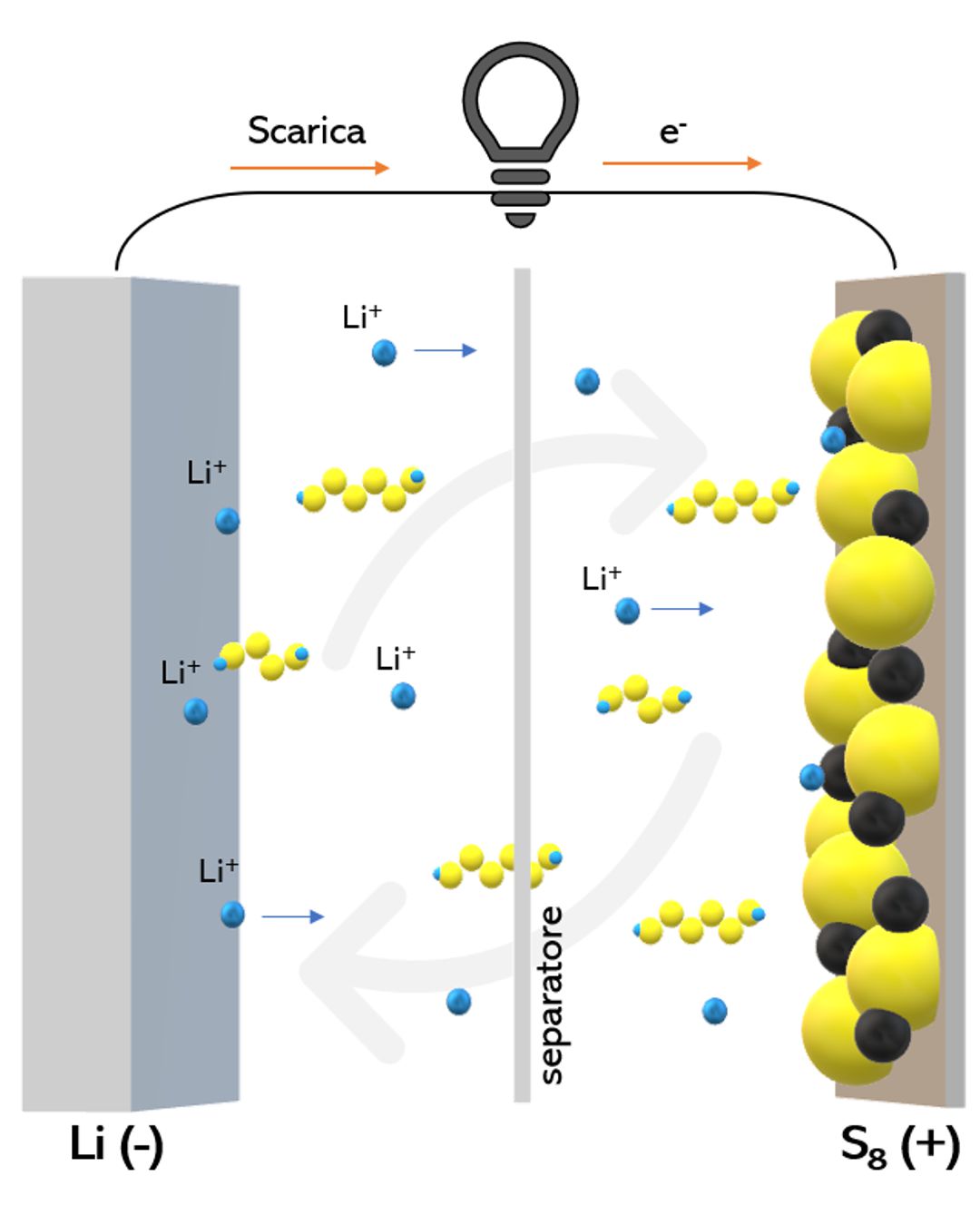
The main one is related to stability over time. During the charging and discharging cycles, intermediate compounds, called polysulphides, are formed and can migrate inside the cell, causing loss of active material and progressive degradation of performance. This phenomenon is known as polysulfide shuttle.
The consequences are:
- reduction of capacity,
- decrease in service life,
- performance instability.
Research therefore focuses on new materials, electrode architectures, and more stable electrolytes, capable of containing these effects.
Potential applications and areas of interest
Despite the challenges, lithium-sulfur batteries remain extremely attractive for all applications where weight and energy density are critical.
Among the main sectors:
- Electric vehicles, especially in the light and high-efficiency segments
- Drones and aerospace, where the energy/weight ratio is decisive
- Stationary storage, for decentralized renewable systems
In these areas, even a partial improvement in performance can result in significant benefits.
The contribution of advanced materials: the role of graphene
In recent years, one of the most promising lines of research on lithium-sulfur batteries concerns the use of advanced two-dimensional materials, in particular graphene and its derivatives.
Graphene, due to its high electrical conductivity, porous structure and large specific surface area, is being studied as a support material for the sulfur-based cathode. In these configurations, it performs a dual function: on the one hand it improves the transport of electrons inside the cell, on the other hand it helps to "trap" polysulfides, reducing the phenomenon of the polysulfide shuttle.
In some experimental prototypes, three-dimensional graphene-based structures have been used to create porous matrices capable of stabilizing sulfur and increasing the cyclic lifetime of cells. This approach does not change the basic chemistry of the battery but optimizes its operation through material engineering.
While these solutions are still in the research phase, they represent a concrete example of how the convergence of chemistry, nanotechnology and materials science can accelerate the development of Li-S batteries.
The road to commercial maturity
Numerous research centers, universities, and startups are working on the industrial scalability of lithium-sulfur batteries. However, the transition from experimentation to mass market still takes time.
The main challenges concern:
- large-scale production,
- long-term reliability,
- integration into existing systems,
- operational safety.
It is realistic to assume that the first widespread commercial applications will arrive gradually, initially in specialized sectors, and then extend to the wider market.
Lithium-sulfur batteries represent one of the most fascinating fronts of energy storage research. With a high theoretical energy density, more sustainable materials and strong development potential, this technology could contribute significantly to the evolution of electric mobility.
At the same time, technical difficulties remain significant and require a multidisciplinary approach, in which chemistry, engineering and materials science work in synergy.
The real revolution will not be the result of a single discovery, but of a long path of research, optimization, and industrialization. And it is precisely on this path that lithium-sulfur batteries continue to represent one of the most interesting bets for the future of energy.
Sources
Rinnovabili.it – Batterie litio-zolfo a ricarica rapida: sfide e strategie
Link: https://www.rinnovabili.it/energia/accumulo/batterie-litio-zolfo-ricarica-rapida/
ScienceDirect – Recent advancements and challenges in deploying lithium-sulfur batteries
Link: https://www.sciencedirect.com/science/article/abs/pii/S2352152X23019564
SaMaterials – Lithium-Sulfur Batteries vs Lithium-Ion Batteries
Link: https://www.samaterials.com/lithium-sulfur-batteries-lithium-ion-batteries.html
BatteryTechOnline – Lithium-Sulfur Batteries: strengths, challenges, and opportunities
Link: https://www.batterytechonline.com/materials/lithium-sulfur-batteries-strengths-challenges-and-opportunities
Large-Battery – Lithium-Sulfur vs Lithium-Ion Batteries
Link: https://www.large-battery.com/blog/lithium-sulfur-vs-lithium-ion-batteries/
MarketsAndMarkets – Lithium-Sulfur Battery Market Analysis
Link: https://www.marketsandmarkets.com/ResearchInsight/lithium-sulfur-battery-market-size.asp
Graphenea – Role of graphene in lithium-sulfur batteries
Link: https://www.graphenea.com/blogs/graphene-news/graphene-role-in-next-generation-lithium-sulfur-batteries
NotizieScientifiche.it – Batterie al litio-zolfo: nuovo passo avanti grazie al grafene
Link: https://notiziescientifiche.it/batterie-al-litio-zolfo-nuovo-passo-avanti-grazie-a-grafene/
- E-BIKE TRANSFORMATION
- HISTORY OF CIAO PIAGGIO
- EVENTS
- ASSEMBLY OF KITS PURCHASED ONLINE
- OUR AUTHORIZED WORKSHOPS
- MAINTENANCE OF E-BIKES AMBRA ITALIA
- ELECTRIC MICRO-MOBILITY
- SCHOOL PROJECT: INNOVATING WITH AMBRA ITALIA
- ELEGANT AND SUSTAINABLE MOBILITY FOR RECEPTION STRUCTURES
- THE WORLD THROUGH CIAO: OUR CUSTOMERS' STORIES
- RESEARCH AND INNOVATION
- BEHIND THE SCENES OF AMBRA ITALIA
- Differences between Ciao SC and PX series frames and impact on transformation
- The people of Ciao
- Ciao endothermic vs Ciao transformed into an e-bike: analysis of operating costs
- How to read and correctly interpret the Operating Instructions
- Because Ciao is beautiful
- Ciao Piaggio and women: a bond to tell
- Interview with a technician: what is it like to work on an electric Ciao?
- The Silence of the Myth – Pedal-Powered Emotions with an Electric Ciao
- Comparative Analysis of Environmental Impact: Ciao Piaggio Endothermic vs Ciao transformed into an E-Bike
- Safety First: Checking the Safety Systems on Ciao Transformed into E-Bikes
- The Longevity of E-Bikes: How Ambra Italia Extends the Life Cycle of the Ciao Piaggio
- The role of Ciao Piaggio transformed into an e-bike in the challenges of contemporary mobility
- Urban Efficiency: How the Ciao Piaggio transformed into E-Bikes by Ambra Italia revolutionize city spaces with style
- Navigating the Regulations: Current and Future Legislation on Electric Micro Mobility
- Post-Transformation Personalization: Opportunities and Limitations
- Ciao Restoration: Options and Tips
- Comparison between the efficiency of an internal combustion engine and an electric engine in mobility
- Building Long-Lasting Customer Relationships: Strategies for Workshops
- Electric rebirth: the Ciao Piaggio in the era of micro mobility
- Ciao Piaggio in cinema and pop culture
- Electricity System Integration: Challenges and Solutions
- Document Writing Philosophy: Everything Under Control
- Micro-Electric Mobility vs. Long-Distance Electric Mobility: Analysis and Perspectives
- The technology behind the myth: mechanical innovations of the Ciao Piaggio
- Compliance with Regulations: Safety and Certifications
- Steps towards Authorization: How to Become an Authorized Ambra Italia Workshop
- Cleaning and Care of your Ciao transformed into an E-Bike: Tips for Aesthetic Maintenance
- The Operating Instructions and Other Documents for the Assembly and Control of the Processes
- Micro Mobility and Social Responsibility: How Companies Can Make a Difference
- From work to free time: the Ciao Piaggio as a symbol of freedom
- The Materials Used
- From Niche to Mainstream: The Evolution of the Electric Micro Mobility Market
- Joining the Ambra Italia Network: Advantages and Opportunities for New Workshops
- Tests on Critical Components: battery and motor system
- Competing icons
- The Ciao and the urban mobility revolution
- E-Bike or electric motorbike? The choice of the type of transformation determines the approval
- The Role of Electric Micro-Mobility in Reducing Urban Pollution
- Collaborating to Innovate: The Flow of Information between Headquarters and Workshops
- Optimize the battery life of your Ambra Italia e-bike
- Quality Controls on Materials
- Design evolution
- Structural Problems
- Security and Micro Mobility. Standards and Recommended Practices for Electric Driving
- The Emoving Days 2024
- The components of the kit: panoramic
- Excellence in the service: Ambra Italia quality standards
- Basic maintenance of the Ambra Italia-Bike: step by step Guide for Newfits
- Keep the original design
- The future is here
- Birth of an icon